From a search field to a digital transformation of the largest door manufacturer in the Czech Republic
SAPELI approached us with a request to change the search field on their website. However, we discovered that the real problem lay within the company’s internal operations. For example, customer support was using the website as their information source. The result is a systemic change that lets SAPELI see the entire customer journey from the first contact through to door installation and service. And competitors cannot easily replicate it.
- Client
- SAPELI a.s.
- Duration of partnership
- 2017–2025
What you will learn
Why a website redesign is often not the solution and where the real problem lay
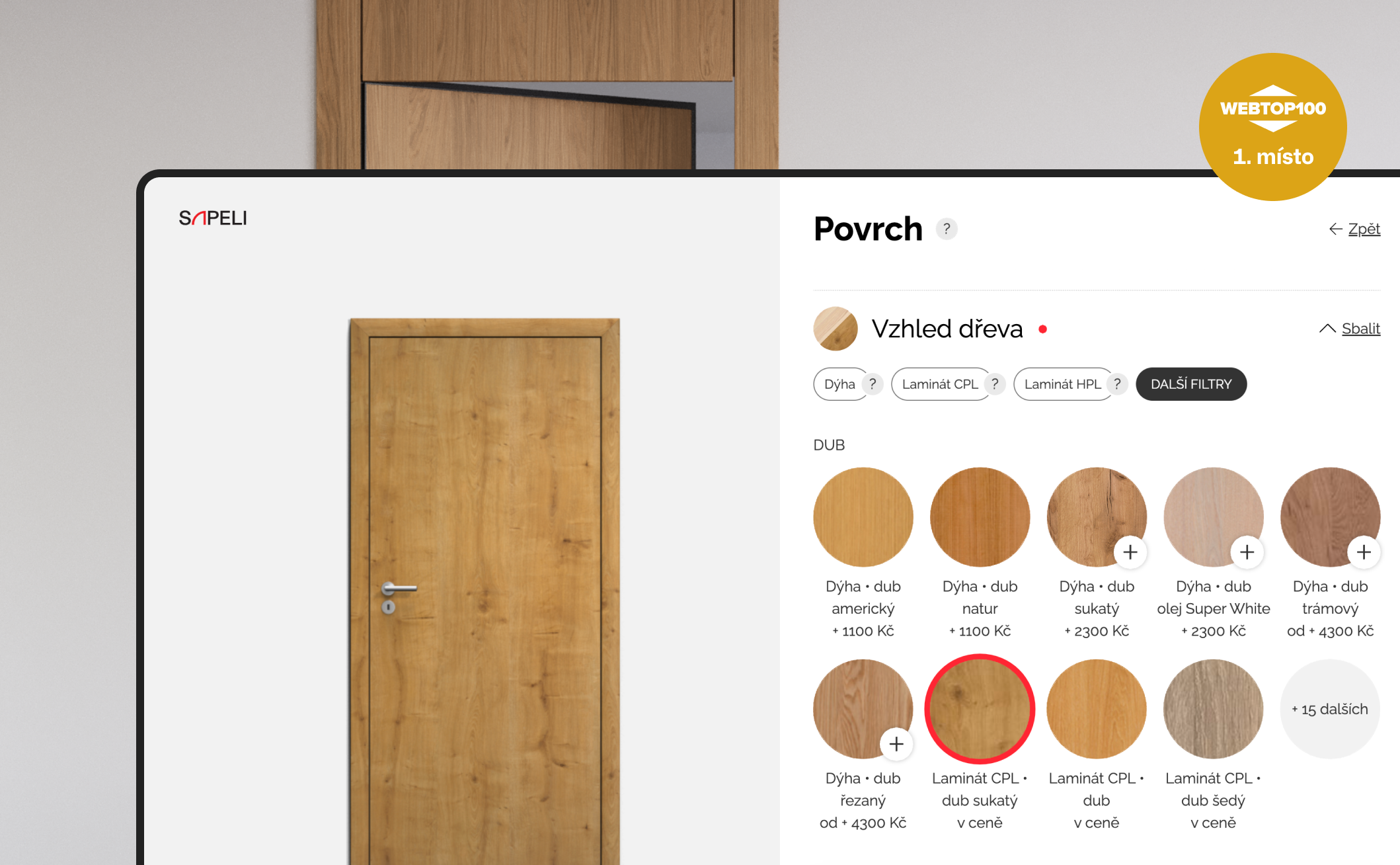
How to design a configurator for 400 million product configurations and how the entire tool fits into the digital transformation
Why 54% of B2B buyers today do not hesitate to switch suppliers due to a poor digital experience
What this means for your company and where to look for similar opportunities
“We want to add search to the website”
The client’s original request was to add a search field to the website. Using the “5 Whys” analysis method, however, we discovered that the real problem was a dysfunctional internal process and a missing knowledge base for customer support. Support was using the website as its only source of information. Moreover, the reality at B2B partner showrooms often did not match SAPELI’s marketing strategy.
The “5 Whys” method may seem simple at first glance, but it reliably uncovers often hidden root causes of problems. As in the SAPELI case:
We need search.
Why? Because support wants search.
Why? Because they use the website as a knowledge base.
Why? Because they have no better sources of information.
Why? Because there are no tools for employee product training.
“It turned out that what was troubling the company was not a missing search field. The problem is that internal processes don’t work and support doesn’t have access to the information it needs.”
Jan Junek, Design Lead, Proof & Reason
6 obstacles that were slowing down SAPELI’s business
Choice paralysis
Customers didn’t know where to start or how to choose correctly from 400 million possible product configurations. They often left without making an enquiry and the company lost them.
Overloaded support
77% of enquiries handled by support were outside its competence. Customers used it as a substitute for missing information.
Complex pricing
A single door can have 12 different prices depending on whether it’s a leaf or a complete set, the VAT rate, or which dealer offered the doors.
Website doesn’t communicate with showrooms
Customers chose at home on the website, but at the showroom they had to start from scratch. There was no way to pass data from the website to the showroom.
120 dealers without oversight
The sales network consists of 120 independent entities. SAPELI had no overview of how dealers handled enquiries.
No visibility of the customer journey
Data on customers, orders, products and pricing was spread across 4 different systems. There was no way to track the entire journey from first contact to final order.
Systematic service redesign and sales digitalisation
Through customer interviews, analysis of support conversations and the aforementioned “5 Whys”, we worked with the client to redefine the project scope and its goals. From improving the website to a systematic redesign of the entire service and customer journey. From the moment a person first learns about SAPELI, through door selection, configuration and purchase at a showroom, all the way to installation and service.
Root cause analysis using “5 Whys”
Systematically finding the real problem, not just the visible symptom
Survey with 1,000 customers
What truly matters to them when choosing doors. From model and colour to durability, hinges, edges and frame type.
Analysis of 6,000 support conversations
Where people have problems, what they ask about and what discourages them.
People–Processes–Technology framework
We ensured the newly designed service and digital transformation was reflected internally – in the team, in processes and in technological infrastructure.
In industrial B2B: a 1-point improvement in customer satisfaction (on a 10-point scale) corresponds to at least 3% revenue growth. Yet improving a single touchpoint is not enough – what matters is the overall experience across the entire journey.
McKinsey, How to boost growth in industrial servicesBridging physical and online worlds: From 4 systems to one
A key change also took place at the systems level. For the entire result to work both internally and for the customer, we needed the doors in the configurator, in the printed catalogue and on the invoice to be the very same item. That sounds simple, but in a company with hundreds of door models and a billion accessory, frame and hardware combinations, it required unifying 4 internal systems into one.
“The thing customers almost always know about their future doors is whether they want solid-colour, wooden or glass. We used these basic properties as a starting point and turned 400 million combinations into a comprehensible path.”
Jan Junek, Design Lead, Proof & Reason
What SAPELI gained
A configurator that sells
Guides the customer step by step: colour → material → properties. Thanks to 70 hours of user testing, its ease of use is comparable to using the Instagram app.
One product, one entity
Doors on the website, in the catalogue, in the configurator and on the invoice are all the same. This significantly reduced errors and simplified internal processes.
QR codes bridging the physical and digital worlds
A photo in a magazine or showroom has a QR code. The customer scans it and instantly has the specific configuration on their phone.
The dealer knows what the customer wants
At the showroom the dealer sees exactly what the customer selected at home. This makes sales more efficient and lets them focus more on customer care.
4 systems → 1 data source
Configuration and pricing logic unified from the previously 4 fragmented internal systems into a central product information repository.
Error-free prices, in real time
Both the customer and the dealer see the exact price including frames, hardware and the correct VAT rate.
How SAPELI sees the entire business case today
We connected the former barriers in sales and the customer’s service journey into a process where each step passes data to the next.
Advert, magazine, trade fair. QR code on a photo → straight to the configurator.
400M+ combinations → a clear selection in just a few clicks. Price in real time.
The dealer sees what the customer prepared. They can pick up where the customer left off on the website.
One product = one record. Configurator, price list and invoicing all read from a single source.
The installation team receives precise specifications from the same data. Error-free.
Support knows the entire history from the first configuration. The customer doesn’t need to repeat anything.
What the partnership has brought the company
SAPELI sees the entire customer journey
From the first magazine advert through repeated web configurations, showroom visits and orders, all the way to installation and service. SAPELI has data for the entire business case from start to finish.
Enquiries go to the best dealers
Thanks to data, the company knows which of the 120 dealers respond fastest and have the best ratings. It assigns enquiries to them preferentially and thus has leverage over the quality of the entire network.
An advantage competitors cannot copy
A new website look can be copied by competitors in a few weeks. But a systemic change of internal processes, data and the sales network? They would have to go through the entire transformation themselves.
Companies that systematically work on customer experience achieve up to 2.5× higher customer retention compared to competitors who neglect this area.
Forrester CX Performance Index, 2025
“Better service is hard to copy. A competitor would have to undergo exactly the same transformation and work through it all internally. But it is precisely this effort that creates a real and sustainable competitive advantage.”
Jan Junek, Design Lead, Proof & Reason
3 recommendations for manufacturing company directors
Don’t take the first brief as final
“We want a new website” is a symptom, not a diagnosis. Before you invest in a solution, ask: What do we want to change and how will it show in the numbers?
The product is only half the story
Your customers aren’t just buying a product – they’re buying the entire customer experience. From selection through ordering to service. Whoever manages this journey better, wins.
Systemic change is hard to copy
A competitor can replicate a new website in a month. But transforming internal processes, unifying data and managing 120 dealers by performance? That takes years of work and is your real long-term competitive advantage.
Customer expectations of digital tool quality are rising
You are probably thinking about digitalising and measuring production, optimisation, automation or improving your ERP system. These are important steps. Equally important is not to overlook how your customers buy and how they communicate with you. This is precisely where the business opportunity and a huge competitive advantage emerge. The SAPELI case shows what such a change looks like in practice and that even a traditional manufacturing company can make it happen.
of B2B buyers are today willing to switch suppliers if they have a poor digital purchasing experience. And e-commerce is for the first time in history the main source of B2B revenue – ahead of in-person sales.
McKinsey B2B Pulse Survey, 2024 (3,400+ respondents)
Frequently asked questions
Do we need to change our ERP or internal systems?
+
No. We work with what you have. We integrate with your existing systems and unify their outputs so they give you a clear overview.
How long does such a transformation take?
+
We deliver the first tangible results (audit, customer journey map, prioritised opportunities) within 3 months. Full implementation depends on the scope of changes. We’ve been working with SAPELI step by step since 2017.
We have specific sales channels – distributors, e-shop and brick-and-mortar stores. Can that even be unified?
+
That’s exactly what we do. At SAPELI we connected 120 independent dealers, website, configuration and service into one process.
What if we don’t know where exactly the problem is?
+
That’s why we start by understanding your industry and analysing: where customers get lost, where processes take too long, where unnecessary costs arise.
Facing a similar situation?
We help companies find the real obstacles in their business processes and turn them into a measurable competitive advantage.

of B2B buyers are considering switching suppliers due to a poor digital experience
higher retention for companies that address customer experience